IELTS Writing Task 2 questions 2026: practice topics by theme and type
Last verified 8 October 2026 · 7 min read · ieltspractice.app
Quick answer
These are 60 original Task 2 practice questions, not real exam questions, grouped by theme and question type. No list can give you your exact question, because test materials must stay in the test room. Write at least 250 words in about 40 minutes.
Free tool · IELTS Task 2 topic generator
Open full pagePick a question type and theme if you like, then press New question. There are 60 original practice questions.
This page does not save or grade anything. Write on paper or in any editor, then check your length with the IELTS word counter.
Want a band score? Writing practice grades a Task 2 essay, but the app chooses its own question, so it will not be this one. Free accounts get 5 graded practices. Pro, our paid plan, lets you choose the question type.
Open Writing practice (it chooses its own question)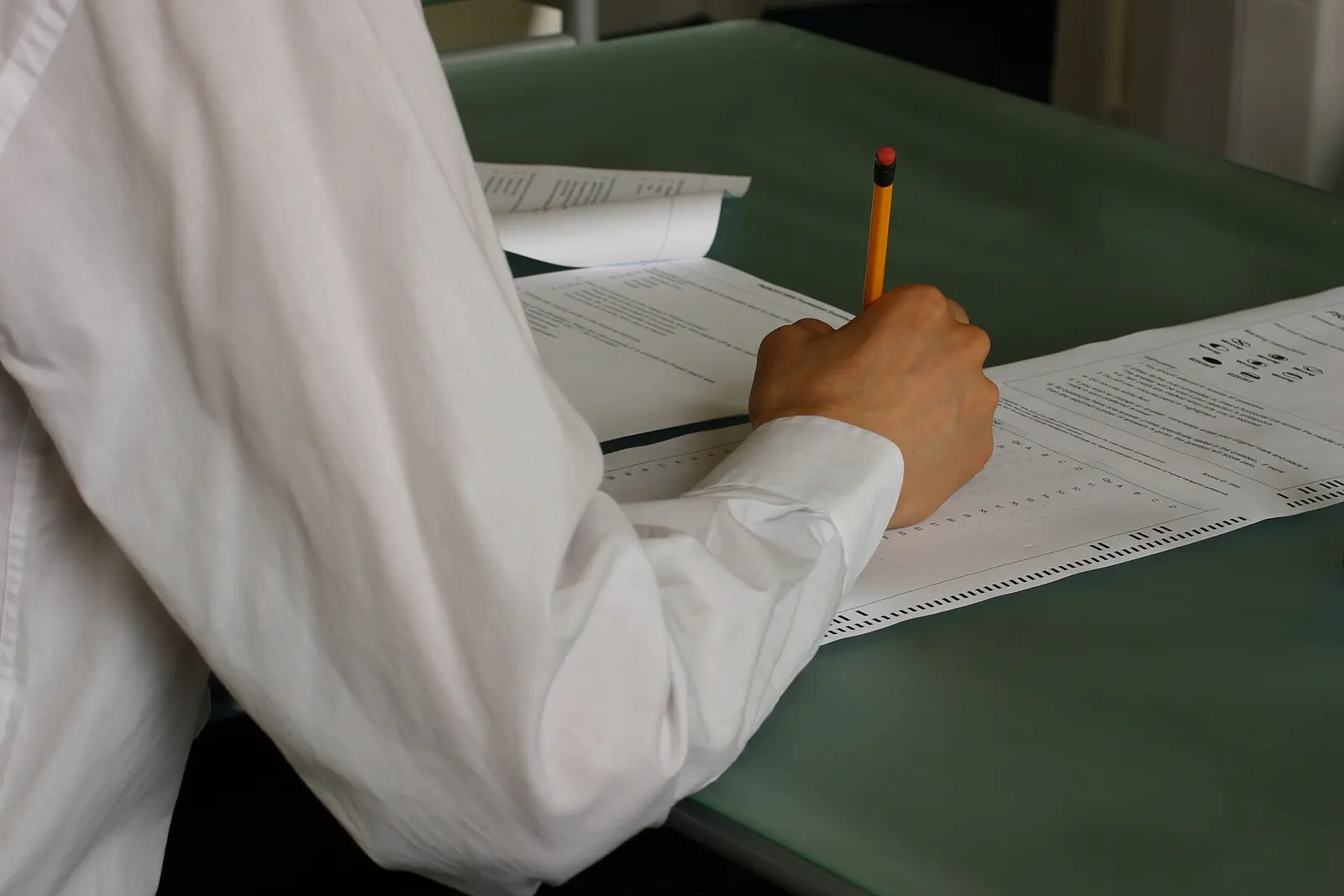
Photo: Alison wood — Wikimedia Commons (CC BY 3.0)
What is IELTS Writing Task 2?
IELTS Writing has two tasks in 60 minutes. In Task 2, IELTS says, you are given a point of view, argument or problem which you need to discuss. You write an essay of at least 250 words, and IELTS suggests about 40 minutes for it.
Task 2 matters more than Task 1. In IELTS’s own words, Task 2 contributes twice as much as Task 1 to the Writing score. That is why it is worth practising Task 2 most.
Task 2 is in both IELTS Academic and IELTS General Training. The length, the time and the weighting are the same in both, so every question on this page works for both tests.
You must write full sentences, not notes or bullet points. IELTS also says you will be penalised if what you write is not related to the topic, so read the question carefully before you plan.
| Question | What IELTS says |
|---|---|
| How long is the Writing test? | 60 minutes |
| How many tasks are there? | 2 |
| How long is Task 2? | At least 250 words, in about 40 minutes |
| How long is Task 1? | At least 150 words, in about 20 minutes |
| Which task counts more? | Task 2 contributes twice as much as Task 1 to the Writing score |
| Can I use bullet points? | No: full sentences, not notes or bullet points |
Our 5 types of Task 2 question and how to answer each
IELTS does not name essay types such as these. We group our questions into five types by what the question asks you to do, because each type needs a different plan.
Opinion (agree or disagree). The question ends “To what extent do you agree or disagree?” Decide how far you agree, say it in your introduction and keep the same view to the end. Read our opinion essay guide.
Discuss both views. The question gives two opinions and ends “Discuss both these views and give your own opinion.” Give each view its own paragraph, then say clearly which view you agree with. See how to discuss both views.
Advantages and disadvantages. The question describes a trend, which means a change that is happening, and asks you to weigh its good and bad sides. Often it asks “Do the advantages outweigh the disadvantages?” Read the advantages and disadvantages guide, with two annotated samples.
Problem and solution. The question asks what problems something causes, or why it happens, and what can be done. Link each solution to a problem you named. Read the problem and solution guide.
Two-part question. The question asks two different direct questions about one topic, for example why something is happening and whether it is good or bad. Answer both, in order. Read the two-part question guide, with two annotated samples.
How to write a Task 2 essay in 40 minutes
Read the question (2 minutes)
Underline the topic and the exact words of the question. Decide which of our five types it is, so you know what your essay must do.
Plan (5 minutes)
Write your answer to the question in one sentence. Then note two main ideas, each with one example, and decide which paragraph each goes in.
Write the introduction (5 minutes)
Say what the topic is in your own words, then give your answer or your plan. Two or three sentences are enough.
Write two body paragraphs (20 minutes)
Start each paragraph with its main idea. Then explain it and give an example from your own knowledge or experience.
Conclude and check (8 minutes)
Repeat your answer in different words, without adding a new idea. Then check your word count, your verbs and your spelling.
IELTS Task 2 questions by theme
Below are two practice questions for each of six themes, with the question type named in bold. The generator at the top of this page has all 60 questions, 10 for each theme.
In the test, every question also ends with this line: “Give reasons for your answer and include any relevant examples from your own knowledge or experience.” We leave it out below to save space, but it applies to every question.
IELTS Task 2 questions on education
Education questions ask about schools, universities, teachers and learning at any age.
Opinion (agree or disagree). Primary schools should stop giving homework, so that young children have more time for play, rest and family life. To what extent do you agree or disagree?
Two-part question. In many families, parents pay for private lessons after school for their children, sometimes starting when the children are very young. Why do parents choose to do this? How might it affect children’s lives outside school?
The generator above has 8 more questions on this theme: choose “Education”.
IELTS Task 2 questions on technology
Technology questions ask how phones, the internet, smart devices and artificial intelligence change work and daily life.
Discuss both views. Some people believe that artificial intelligence will create more jobs than it replaces. Others fear that many workers will be left without employment as machines take over their tasks. Discuss both these views and give your own opinion.
Advantages and disadvantages. In many homes, voice assistants and other smart devices now control the lights, the heating and even the weekly shopping list. Do the advantages outweigh the disadvantages?
The generator above has 8 more questions on this theme: choose “Technology”.
IELTS Task 2 questions on the environment
Environment questions ask about pollution, transport, energy, water and the weather.
Advantages and disadvantages. In a number of cities, private cars are no longer allowed in the centre, and the streets are being given over to people walking and cycling. Do the advantages outweigh the disadvantages?
Problem and solution. Summers in many cities are becoming hotter, and heatwaves now last longer than they once did. What problems does this cause and what solutions can you suggest?
The generator above has 8 more questions on this theme: choose “Environment”.
IELTS Task 2 questions on health
Health questions ask about doctors, exercise, food, loneliness and how long people live.
Discuss both views. Some people believe that the government should provide free medical care for everyone. Others think people should pay for at least part of their own treatment. Discuss both these views and give your own opinion.
Two-part question. Many people buy vitamin pills and other health supplements, even when a doctor has not advised them to take any. Why do people do this? Is it a sensible way to spend their money?
The generator above has 8 more questions on this theme: choose “Health”.
IELTS Task 2 questions on crime and the law
Crime questions ask about punishment, the police, the courts and crime on the internet.
Opinion (agree or disagree). Young people who commit minor crimes for the first time should do unpaid work in their community instead of being sent to prison. To what extent do you agree or disagree?
Problem and solution. Online fraud, in which criminals trick people into sharing their passwords or bank details, is becoming more common. What problems does this cause and what solutions can you suggest?
The generator above has 8 more questions on this theme: choose “Crime and the law”.
IELTS Task 2 questions on government
Government questions ask what the state should pay for, control or leave to people.
Discuss both views. Some people believe every adult should receive a basic monthly payment from the government, whether or not they work. Others argue that this money would do more good if it went only to people in need. Discuss both these views and give your own opinion.
Two-part question. Some local governments now let residents vote online on how part of the town’s budget should be spent. Why might a government choose to involve citizens in this way? What difficulties could this approach face?
The generator above has 8 more questions on this theme: choose “Government”.
How is Task 2 marked?
An examiner marks your essay on the four criteria in the table below, so a good essay needs all four, not just good grammar.
Task response is about the question. An essay with good English can still lose marks here if it does not answer every part of the question.
Coherence and cohesion is about order and linking: one main idea per paragraph, and words such as “however” and “this” that join your ideas. Lexical resource means your vocabulary, and grammatical range and accuracy means your grammar.
To check the length of a practice essay, paste it into our IELTS word counter. It shows at once whether you wrote at least 250 words.
| Criterion | What it assesses |
|---|---|
| Task response | How accurately, appropriately and relevantly your answer covers the task. In Task 2, it includes how well you develop your argument, with evidence and examples. |
| Coherence and cohesion | How clear and fluent your writing is, and how you organise ideas and information, including linking words. |
| Lexical resource | The range of vocabulary you use, and how accurately and appropriately you use it. |
| Grammatical range and accuracy | The range of grammar you use, and how accurately and appropriately you use it. |
Band 9 sample answers by question type
- Opinion: compulsory community service in schools
- Opinion: crime and justice
- Opinion: government and public spending
- Opinion: sport and health
- Opinion: taxing junk food
- Opinion: space exploration or problems on Earth
- Discuss both views: the environment and individual action
- Discuss both views: will AI replace teachers?
- Discuss both views: globalisation and culture
- Discuss both views: tourism and travel
- Discuss both views: family and society
- Discuss both views: online learning or the classroom
- Discuss both views: privacy and surveillance
- Advantages and disadvantages: social media
- Advantages and disadvantages: work and careers
- Advantages and disadvantages: working from home
- Problem and solution: rising obesity
- Problem and solution: advertising and shopping
- Problem and solution: growing cities
- Problem and solution: fast fashion
Writing Task 1 guides
- Academic: bar chart, with Band 7 and Band 9 samples
- Academic: pie chart, with Band 7 and Band 9 samples
- Academic: table, with Band 7 and Band 9 samples
- Academic: multiple charts, with Band 7 and Band 9 samples
- General Training: informal letter, with samples
- General Training: semi-formal letter, with samples
In this guide

Frequently asked questions
Are these real IELTS Writing Task 2 exam questions?
No. They are original practice questions, not real exam questions. Our team wrote them in the style of the test. Test materials must stay in the test room, so be careful with any list that claims to have this year’s questions. Practise our five question types instead.
How many words should a Task 2 essay be?
You must write at least 250 words, and IELTS suggests about 40 minutes. IELTS says you will not be penalised for writing more than 250 words, but a very long answer may leave you no time to check. Aim for about 260 to 300 words, so you are safely over the minimum.
How is IELTS Writing Task 2 marked?
On four criteria: Task response, Coherence and cohesion, Lexical resource, and Grammatical range and accuracy. Task 2 contributes twice as much as Task 1 to the Writing score, so a strong Task 2 essay matters more than a strong Task 1 answer.
How do I practise Task 2 with a timer?
Use the topic generator at the top of this page. Choose a type and a theme, press New question, then start the 40-minute timer and write by hand or in a document. This page does not grade anything. For a practice band estimate, open Writing practice: the app gives you its own Task 2 question, and free accounts get 5 graded practices.
Is Task 2 the same in IELTS Academic and General Training?
The rules are the same: at least 250 words in about 40 minutes, and Task 2 counts twice as much as Task 1 in both tests. IELTS says the General Training Task 2 is a semi-formal or neutral essay. Our practice questions work for both tests.
What are the types of IELTS Writing Task 2 essay?
IELTS does not name a fixed set of essay types. We group our questions into five types by what they ask you to do: opinion (agree or disagree), discuss both views, advantages and disadvantages, problem and solution, and two-part questions.
Sources
- IELTS (ielts.org): IELTS Academic format, Writing
- IELTS (ielts.org): IELTS General Training format, Writing
- IDP IELTS India: notice to candidates (test materials stay in the test room)
Facts on this page last checked against these sources on 8 October 2026.
Keep reading
Independent IELTS preparation. ieltspractice.app is not affiliated with IDP, Cambridge English, or the British Council.