IELTS study plan for 1, 2 or 3 months at home, without coaching
Last verified 11 November 2026 · 7 min read · ieltspractice.app
Quick answer
A good IELTS study plan gives the most days to your weakest skill, practises on most days and adds a full timed mock about every four weeks. Enter your test date and target below to get a free week-by-week plan with your next step each day.
Free tool · IELTS study plan builder
Open full page8-week plan · target 6.5
Most days go to: Writing, then Speaking
- A free account includes 5 graded practices in each of Reading, Listening and Writing, and 1 full mock of each. This plan has 6 Reading, 6 Listening and 14 Writing practice days and 6 mock days. Days past the free allowance are marked Pro, our paid plan, and so is the full Speaking test.
Days per skill
- Listening8 days
- Reading8 days
- Writing16 days
- Speaking16 days
Week 1 · Build skills
Day 1
Writing Task 2: plan, then write
Spend 5 minutes on a plan, then write the essay. Read the feedback and rewrite one paragraph.
60 minFree account
Day 2
Speaking: one cue card out loud
Use the cue card generator to get a topic card. You get 1 minute to prepare, then you talk for 2 minutes. Record yourself on your phone and listen back.
60 minFree, no account
Day 3
Reading practice (Academic)
Do one Reading passage. Then find the line in the text that proves each answer.
60 minFree account
Day 4
Writing Task 1: describe a chart
Write your answer, then read the feedback on each marking area.
60 minFree account
Day 5
Speaking: one cue card out loud
Use the cue card generator to get a topic card. You get 1 minute to prepare, then you talk for 2 minutes. Record yourself on your phone and listen back.
60 minFree, no account
Day 6
Listening practice
Do one Listening practice. Then listen again to every question you got wrong and find the words you missed.
60 minFree account
Day 7
Review your week
Look back at this week's results on your dashboard and write down your 3 most common mistakes.
60 minFree account
Week 2 · Build skills
Day 1
Writing Task 2: plan, then write
Spend 5 minutes on a plan, then write the essay. Read the feedback and rewrite one paragraph.
60 minFree account
Day 2
Speaking: one cue card out loud
Use the cue card generator to get a topic card. You get 1 minute to prepare, then you talk for 2 minutes. Record yourself on your phone and listen back.
60 minFree, no account
Day 3
Reading practice (Academic)
Do one Reading passage. Then find the line in the text that proves each answer.
60 minFree account
Day 4
Writing Task 2: plan, then write
Spend 5 minutes on a plan, then write the essay. Read the feedback and rewrite one paragraph.
60 minFree account
Day 5
Speaking: one cue card out loud
Use the cue card generator to get a topic card. You get 1 minute to prepare, then you talk for 2 minutes. Record yourself on your phone and listen back.
60 minFree, no account
Day 6
Listening practice
Do one Listening practice. Then listen again to every question you got wrong and find the words you missed.
60 minFree account
Day 7
Review your week
Look back at this week's results on your dashboard and write down your 3 most common mistakes.
60 minFree account
Week 3 · Practise by type
Day 1
Writing Task 1: one question type
Practise the Task 1 type you find hardest. Your first Writing practice by question type is free; more are part of Pro.
60 minFree account
Day 2
Speaking: a cue card and follow-up questions
Do one cue card (a topic card for a 2-minute talk), then answer the Part 3 questions that follow it, out loud.
60 minFree, no account
Day 3
Reading: one question type
Practise the question type you get wrong most. Your first practice by question type in each skill is free; more are part of Pro.
60 minFree account
Day 4
Writing Task 2: one question type
Practise the essay type you find hardest. Your first Writing practice by question type is free; more are part of Pro.
60 minPro
Day 5
Speaking: a cue card and follow-up questions
Do one cue card (a topic card for a 2-minute talk), then answer the Part 3 questions that follow it, out loud.
60 minFree, no account
Day 6
Listening: one question type
Practise the question type you get wrong most. Your first practice by question type in each skill is free; more are part of Pro.
60 minFree account
Day 7
Review your week
Look back at this week's results on your dashboard and write down your 3 most common mistakes.
60 minFree account
Week 4 · Mock week
Day 1
Mock: full Listening test
4 sections, 40 questions, about 30 minutes of audio, played once. Allow about 40 minutes in all.
40 minFree account
Day 2
Mock: full Reading test
3 passages, 40 questions, 60 minutes.
60 minFree account
Day 3
Mock: full Writing test
Task 1 and Task 2 in 60 minutes.
60 minFree account
Day 4
Speaking: a full test with the AI examiner
The full three-part test is part of Pro. On a free account, your one Part 1 trial unlocks after 2 short tests.
15 minPro
Day 5
Fix your weakest skill: Writing Task 2 in 40 minutes
Write on the 40-minute timer with no breaks, then check your word count.
60 minPro
Day 6
Fix your next skill: Speaking: two cue cards in a row
Do two cue cards (topic cards for 2-minute talks) one after the other, with no break between them.
60 minFree, no account
Day 7
Review your week
Look back at this week's results on your dashboard and write down your 3 most common mistakes.
60 minFree account
Week 5 · Practise by type
Day 1
Writing Task 1: one question type
Practise the Task 1 type you find hardest. Your first Writing practice by question type is free; more are part of Pro.
60 minPro
Day 2
Speaking: a cue card and follow-up questions
Do one cue card (a topic card for a 2-minute talk), then answer the Part 3 questions that follow it, out loud.
60 minFree, no account
Day 3
Reading: one question type
Practise the question type you get wrong most. Your first practice by question type in each skill is free; more are part of Pro.
60 minPro
Day 4
Writing Task 2: one question type
Practise the essay type you find hardest. Your first Writing practice by question type is free; more are part of Pro.
60 minPro
Day 5
Speaking: a cue card and follow-up questions
Do one cue card (a topic card for a 2-minute talk), then answer the Part 3 questions that follow it, out loud.
60 minFree, no account
Day 6
Listening: one question type
Practise the question type you get wrong most. Your first practice by question type in each skill is free; more are part of Pro.
60 minPro
Day 7
Review your week
Look back at this week's results on your dashboard and write down your 3 most common mistakes.
60 minFree account
Week 6 · Timed practice
Day 1
Writing Task 2 in 40 minutes
Write on the 40-minute timer with no breaks, then check your word count.
60 minPro
Day 2
Speaking: two cue cards in a row
Do two cue cards (topic cards for 2-minute talks) one after the other, with no break between them.
60 minFree, no account
Day 3
Reading practice on the timer
Do one Reading passage on the timer, then check every wrong answer.
60 minFree account
Day 4
Writing Task 1 in 20 minutes
Write on the 20-minute timer, then check your word count.
60 minPro
Day 5
Speaking: two cue cards in a row
Do two cue cards (topic cards for 2-minute talks) one after the other, with no break between them.
60 minFree, no account
Day 6
Listening practice, no pausing
Do one Listening practice without pausing, then check your answers and your spelling.
60 minFree account
Day 7
Review your week
Look back at this week's results on your dashboard and write down your 3 most common mistakes.
60 minFree account
Week 7 · Timed practice
Day 1
Writing Task 2 in 40 minutes
Write on the 40-minute timer with no breaks, then check your word count.
60 minPro
Day 2
Speaking: two cue cards in a row
Do two cue cards (topic cards for 2-minute talks) one after the other, with no break between them.
60 minFree, no account
Day 3
Reading practice on the timer
Do one Reading passage on the timer, then check every wrong answer.
60 minFree account
Day 4
Writing Task 2 in 40 minutes
Write on the 40-minute timer with no breaks, then check your word count.
60 minPro
Day 5
Speaking: two cue cards in a row
Do two cue cards (topic cards for 2-minute talks) one after the other, with no break between them.
60 minFree, no account
Day 6
Listening practice, no pausing
Do one Listening practice without pausing, then check your answers and your spelling.
60 minFree account
Day 7
Review your week
Look back at this week's results on your dashboard and write down your 3 most common mistakes.
60 minFree account
Week 8 · Mock week
Day 1
Mock: full Listening test
4 sections, 40 questions, about 30 minutes of audio, played once. Allow about 40 minutes in all.
40 minPro
Day 2
Mock: full Reading test
3 passages, 40 questions, 60 minutes.
60 minPro
Day 3
Mock: full Writing test
Task 1 and Task 2 in 60 minutes.
60 minPro
Day 4
Speaking: a full test with the AI examiner
The full three-part test is part of Pro. On a free account, your one Part 1 trial unlocks after 2 short tests.
15 minPro
Day 5
Fix your weakest skill: Writing Task 1 in 20 minutes
Write on the 20-minute timer, then check your word count.
60 minPro
Day 6
Fix your next skill: Speaking: two cue cards in a row
Do two cue cards (topic cards for 2-minute talks) one after the other, with no break between them.
60 minFree, no account
Day 7
Review your week
Look back at this week's results on your dashboard and write down your 3 most common mistakes.
60 minFree account
The Free account and Pro labels assume you have not used any of your free practices or free mocks yet.
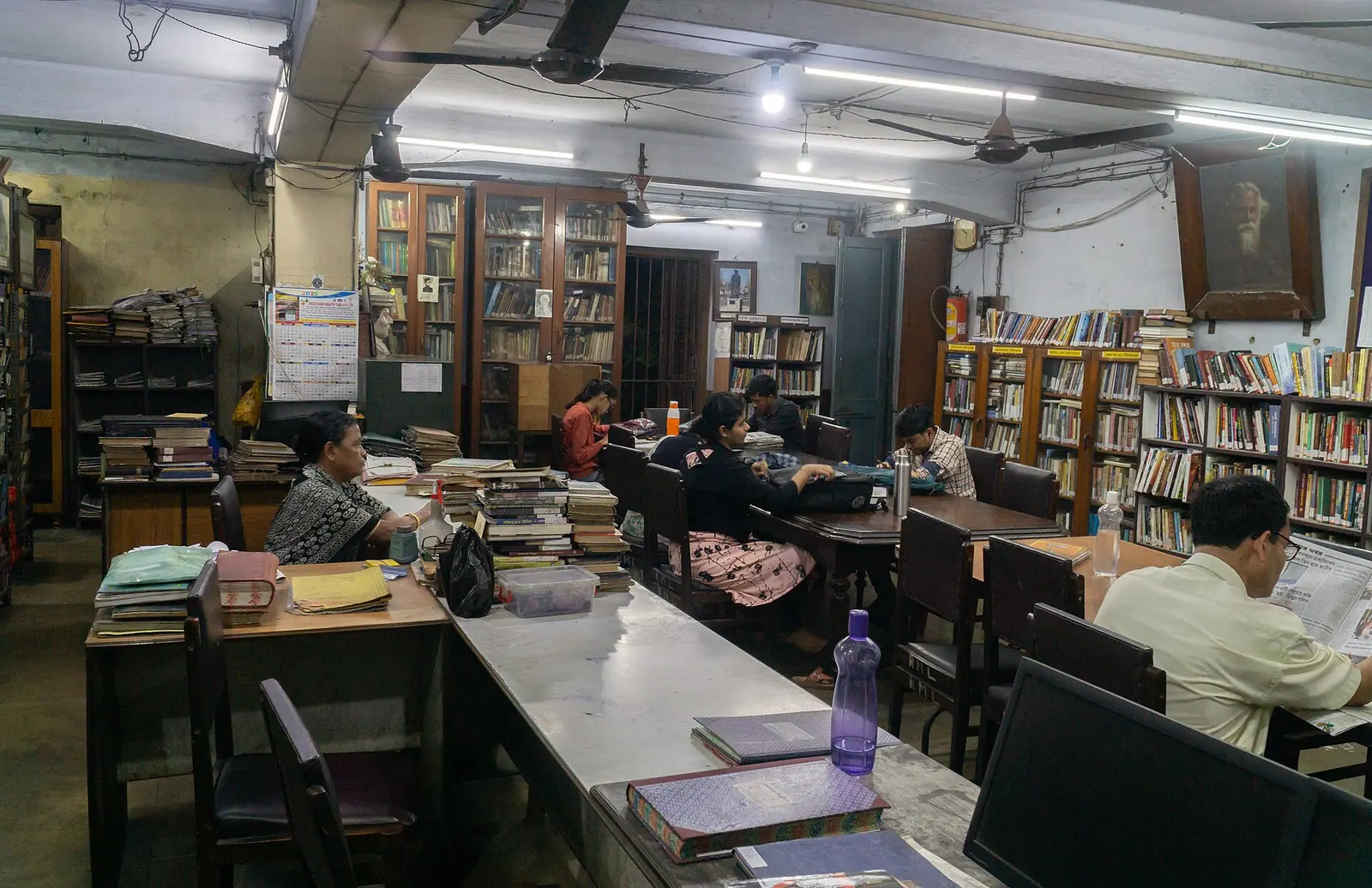
Photo: Sumitsurai — Wikimedia Commons (CC BY-SA 4.0)
IELTS preparation at home without coaching: can you pass?
Yes, you can prepare for IELTS at home. A coaching centre gives you three things: feedback on your answers, regular practice and timed mock tests. At home, you can replace each of them.
Feedback: our Writing grader marks your answers to our own Task 1 and Task 2 practice questions. It gives a practice band estimate on each of four marking areas (answering the question, organisation, vocabulary and grammar), and grading usually takes under a minute. For Speaking, the full test with our AI examiner is part of Pro, our paid plan. A free account gets one Part 1 trial after 2 short tests, with feedback but no score.
Practice: work on one question type at a time, starting with the one you get wrong most. Your first question-type drill in each of Reading, Listening and Writing is free, and more drills are part of Pro. A free account includes 5 graded practices in each of Reading, Listening and Writing, and the free drill is one of them.
Mocks: a full timed mock shows your level. A free account includes 1 full mock in each of Reading, Listening and Writing. For more, use the free practice tests from the IELTS partners in the table further down.
A teacher can still help if you want someone to keep you working or to answer your questions. If you are preparing alone, our 4-week IELTS preparation guide explains what to focus on each week.
Ready-made plans: 1, 2 or 3 months
Pick the plan that matches the time you have before your test: a 1-month IELTS study plan, a 2-month plan or a 3-month plan. Each link opens the plan builder with that number of weeks.
Then set your band in each skill and your target, and the plan changes with them. You can also enter your test date instead, for a plan of up to 26 weeks.
The three sections below show how each plan is built, week by week. Each of these three plans has the same four kinds of week: build skills, practise by type, timed practice and mock weeks.
IELTS study plan for 1 month (4 weeks)
Week 1: Build skills
Do one practice a day, and give the most days to your weakest skill. After each practice, go back to every wrong answer and find out why it was wrong.
Week 2: Practise by type
Choose the question type you get wrong most in each skill, and practise it on its own. Your first drill in each of Reading, Listening and Writing is free, and the plan marks later drills Pro.
Week 3: Timed practice
Do every practice on the timer, with no pauses. Write Task 1 in about 20 minutes and Task 2 in about 40 minutes, as in the real test.
Week 4: Mock week
Take a full Listening, Reading and Writing mock on separate days, and a Speaking test. The full Speaking test is part of Pro; without it, practise two cue cards out loud. A cue card is the topic card for the 2-minute talk in Part 2. Spend days 5 and 6 on your two weakest skills.
IELTS study plan for 2 months (8 weeks)
Weeks 1–2: Build skills
One practice a day, with the most days on the skill furthest from your target. Learn from every wrong answer, and review your week on day 7.
Weeks 3 and 5: Practise by type
Work on the question types you get wrong most, one at a time. Week 4 is a mock week, so you start week 5 after seeing your mock results.
Weeks 6–7: Timed practice
Do every practice on the timer, with no pauses, as you will in the test. Check your word count after each Writing answer.
Weeks 4 and 8: Mock weeks
Week 4 is your halfway check, and week 8 is your last week before the test. Each mock week has a full Listening, Reading and Writing mock and a Speaking test, then two days on your weakest skills. A free account includes 1 full mock in each of Reading, Listening and Writing, so for later mocks use the free partner tests below, or Pro.
IELTS study plan for 3 months (12 weeks)
Weeks 1–3: Build skills
Three weeks of one practice a day, with the most days on your weakest skill. Find out why each wrong answer was wrong before you move on.
Weeks 5–7: Practise by type
After your first mock in week 4, practise the question types that the mock showed you get wrong, one type at a time.
Weeks 9–11: Timed practice
Practise on the timer, with no pauses. By now, aim to finish every task in the real test time.
Weeks 4, 8 and 12: Mock weeks
Three mock weeks let you compare your scores across the plan. A free account includes 1 full mock in each of Reading, Listening and Writing, so for later mocks use the free partner tests below, or Pro.
Not sure of your level? Take a diagnostic mock first
A diagnostic mock is a full timed test that you take before you start, to find your level. Enter your bands in the builder, and the plan gives your weakest skill the most days. A free account includes 1 full mock in each of Reading, Listening and Writing: see what you get in a free IELTS mock test.
You can also choose Not sure for a skill in the builder. Day 1 then becomes a Listening mock, and your score shows where to start. To see what your band and your target mean, read what each IELTS band score means.
How the plan builder decides your week
The builder compares your band in each skill with your target. The skill with the biggest gap gets 2 or 3 days a week: 3 when it is a full band or more behind the next skill. In a tie, Writing and Speaking come first, because they are the hardest to mark yourself.
Day 7 is always a review of your week. Your last week is a mock week. So are week 4, week 8 and every fourth week after, unless that week is just before your last week. A mock week has a Listening, a Reading and a Writing mock, plus a Speaking test.
Each day shows what it needs: no account, a free account or Pro. The builder counts your free practices and mocks as if you have not used any yet, so the days after they run out are marked Pro.
An example: Silva has 8 weeks, a 5.5 in every skill and needs 6.5. Every skill is 1 band short, so Writing and Speaking come first. In week 1, day 1 is Writing, day 2 Speaking, day 3 Reading, day 4 Writing, day 5 Speaking, day 6 Listening and day 7 a review. Silva’s two Writing days are a Task 2 essay and a Task 1 chart.
What the real IELTS test looks like
Your plan should match the real test. The table shows the time and the tasks for each part, so you know what each practice is preparing you for.
| Part | Time | Questions or tasks |
|---|---|---|
| Listening | About 30 minutes | 4 parts and 40 questions, 1 mark each. You hear each recording once only. |
| Reading | 60 minutes | 3 sections and 40 questions, 1 mark each. Academic texts add up to 2,150–2,750 words, and General Training texts to 2,150–2,375 words. |
| Writing | 60 minutes | 2 tasks. Task 1: at least 150 words in about 20 minutes. Task 2: at least 250 words in about 40 minutes. Task 2 contributes twice as much as Task 1 to the Writing score. |
| Speaking | 11–14 minutes | 3 parts: an interview on familiar topics, a 2-minute talk from a task card after 1 minute to prepare, and a discussion. It is a face-to-face interview with an examiner, and it is recorded. |
A daily IELTS routine at home
The builder asks how long you can study each day: 30, 60, 90 or 120 minutes. Most days are one practice, so the plan works from 30 minutes a day. Mock days take about as long as the full test. Allow about 40 minutes for Listening (the audio is about 30 minutes), and 60 minutes for Reading and Writing. A Task 2 day takes at least 40 minutes.
In 30 minutes: do one practice, then spend the rest of the time on your mistakes. In Reading, find the line in the text that proves each answer. In Listening, play the part again and find the words you missed.
In 60 minutes: write a Task 2 essay on the timer and read the feedback carefully. Or do one practice in your weakest skill, then write down the words and phrases you did not know.
With 90 or 120 minutes, add a second practice or a cue card out loud, but keep day 7 for your review. Study at the same time each day if you can, with your phone on silent. A short practice every day is easier to keep up than a long session once a week.
Free IELTS practice tests from the IELTS partners
For more mocks than a free account includes, use the free practice materials from the IELTS partners in the table below. Each one is listed in Sources at the end of this page.
| Provider | What it is | Find it in Sources |
|---|---|---|
| IDP IELTS | A free familiarisation test that shows what IELTS on computer looks like: Listening, Academic Reading and Academic Writing. It is untimed, and the answers are published so you can check your own. | IDP: Free IELTS on Computer familiarisation test |
| British Council | Free practice tests for all four skills, for IELTS Academic and General Training, with answer keys. | British Council: Free IELTS practice tests |
| IELTS (ielts.org) | Free sample test questions and answers, for IELTS Academic and General Training. | IELTS: Sample test questions |
| IELTS (ielts.org) | The IELTS Trial Test: a free, timed test of Listening, Reading and Writing at a participating test location, marked by an IELTS examiner. Its scores are not official. | IELTS: IELTS Trial Test |
Guides for each part of your plan
Start day 1 of your plan
Create a free account, open your dashboard and do day 1 of your plan. Your free practices cover the first days, and the plan marks each day that needs Pro.Start practising free
Frequently asked questions
Can I pass IELTS without coaching?
Yes, you can prepare at home. Coaching gives you feedback, regular practice and timed mocks, and you can get each of these at home with practice by question type, a Writing grader and full mock tests. No one can promise you a band, with or without coaching.
Is there an IELTS study plan for 1 month PDF?
We do not offer a PDF. Build your 4-week plan with the builder on this page, then press Copy plan to copy it as text that you can paste into your notes. The builder also keeps your plan in this browser, so it is still there when you come back.
IELTS ki taiyari kaise kare (how do I prepare for IELTS at home)?
Start with your test date and the band you need. Build a plan on this page, then follow it one day at a time. Do one practice a day, with the most days on your weakest skill, a timed mock every four weeks and a review on day 7.
IELTS korbo kivabe: where do I start?
Start with day 1 of your plan. If you do not know your level, choose Not sure in the builder: day 1 then becomes a Listening mock, and your score shows where to start. A free account includes 1 full mock in each of Reading, Listening and Writing.
How many hours a day should I study for IELTS?
IELTS does not set a number, and the right amount depends on your level and your test date. Most days are one practice, so the plan works from 30 minutes a day, and you can choose 30, 60, 90 or 120 minutes. Mock days take about as long as the full test. Allow about 40 minutes for Listening (the audio is about 30 minutes), and 60 minutes for Reading and Writing. A Task 2 day takes at least 40 minutes. A short practice every day is easier to keep up than a long session once a week.
How long does it take to go from band 6 to 7?
No one can promise a time: it depends on your skills now and how much you practise. Plan with the weeks you really have before your test, and check your progress with a mock every four weeks. If your gap is big and your test is close, choose a later date if you can.
Sources
- IELTS: IELTS Academic Listening test format
- IELTS: IELTS Academic Reading test format
- IELTS: IELTS General Training Reading test format
- IELTS (ielts.org): IELTS Academic format, Writing
- IELTS (ielts.org): IELTS General Training format, Writing
- IELTS: IELTS Academic Speaking test format
- IDP: Free IELTS on Computer familiarisation test
- British Council: Free IELTS practice tests
- IELTS: Sample test questions
- IELTS: IELTS Trial Test
Facts on this page last checked against these sources on 11 November 2026.
Key figures from 2 of 10 sources were re-checked automatically on 15 November 2026.
Keep reading
Independent IELTS preparation. ieltspractice.app is not affiliated with IDP, Cambridge English, or the British Council.