IELTS Speaking practice online with AI: what is free, and how to use it
Last verified 11 November 2026 · 5 min read · ieltspractice.app
Quick answer
You can practise IELTS Speaking online with an AI examiner that asks you questions out loud and gives feedback on the four Speaking criteria. A free account unlocks one Part 1 trial after 2 short tests. The full three-part test with a practice score is part of Pro.
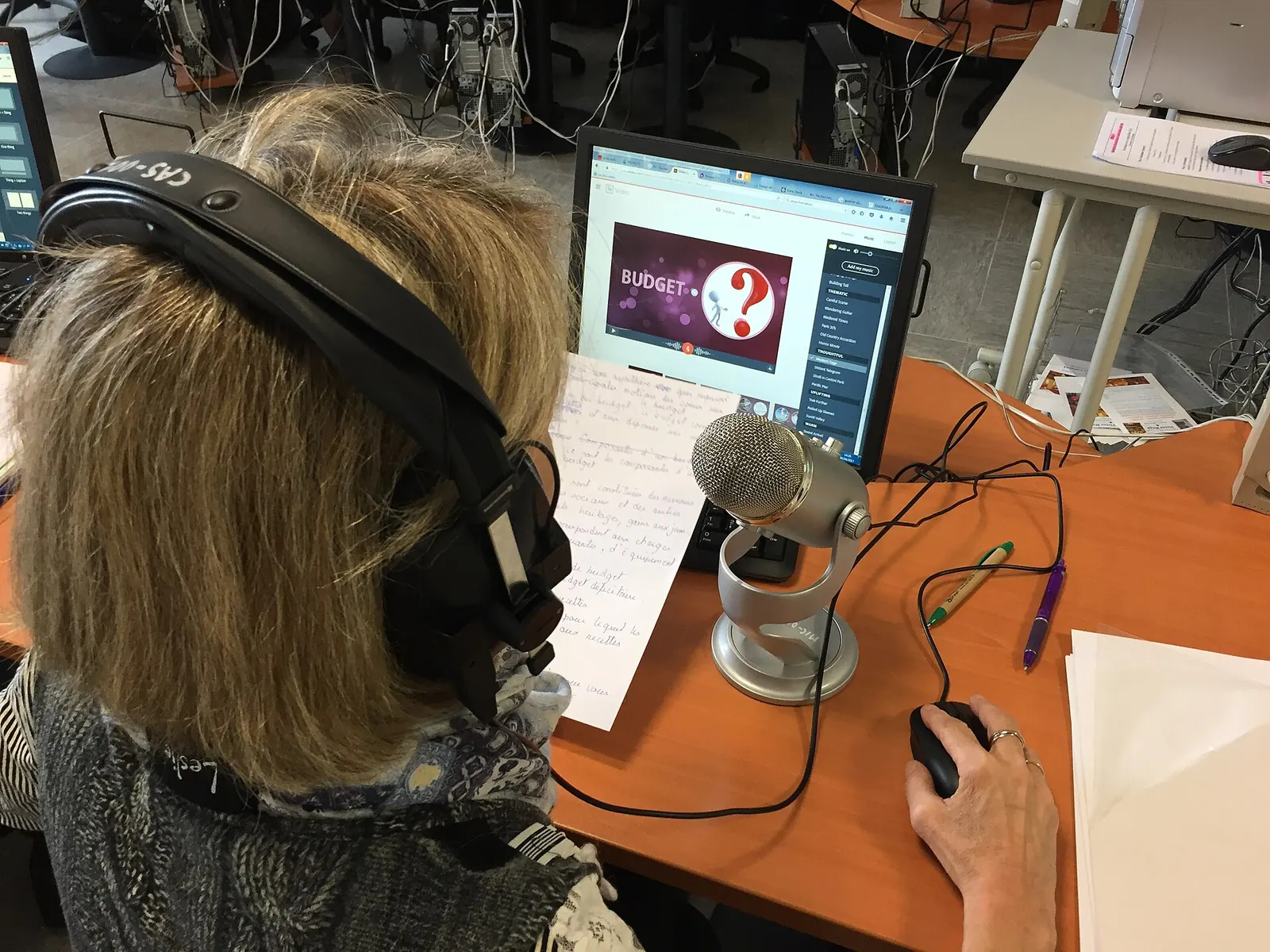
Photo: Guillaume Bonzoms — Wikimedia Commons (CC0)
Can I practise IELTS speaking with AI for free?
Yes, once. Every free account on IELTS Practice includes one Speaking interview with the AI examiner. It covers Part 1 only and lasts up to 5 minutes.
To unlock it, finish 2 short tests in Reading, Listening or Writing. Practice tests and mock tests both count, and both can be in the same skill. A Writing answer of 20 words or fewer does not count.
After the interview you get written feedback on the four Speaking criteria and a vocabulary report. You do not get a number. There is also a daily limit on trial interviews across the whole site. If it is full, your free interview stays reserved and you can come back the next day.
The full 3-part Speaking interview with the live AI examiner is part of Pro, and each full test ends with a practice score. See what IELTS Practice Pro includes.
| Part | How long | What happens |
|---|---|---|
| Part 1: Introduction and interview | 4–5 minutes | The examiner introduces themselves and checks your identity. Then they ask general questions on familiar topics, such as home, family, work, studies or interests. |
| Part 2: Long turn | 3–4 minutes, including 1 minute to prepare | The examiner gives you a task card. You have one minute to prepare, with a pencil and paper for notes. Then you talk for 2 minutes, and the examiner may ask one or two questions on the same topic. |
| Part 3: Discussion | 4–5 minutes | You and the examiner discuss issues linked to the Part 2 topic, in a more general and abstract way. |
| The whole test | 11–14 minutes | A face-to-face interview with an examiner, and it is recorded. It is the same in IELTS Academic and IELTS General Training. |
How AI speaking practice works on IELTS Practice
The AI examiner speaks to you out loud, and you answer through the microphone on your phone or computer. A full test has all three parts: the Part 1 interview, the Part 2 long turn with a minute to prepare, and the Part 3 discussion.
At the end you get written feedback on each of the four criteria: what you did well and what to work on next. You also get a vocabulary report, with words you used well and better words for some of the things you said.
The feedback is based on a transcript, which is a written record of what you said, not on the sound of your voice. So the Pronunciation feedback is limited, and it says so. The results page says: “Practice guidance to help you improve — not an official IELTS band score.”
In the real test, examiners give a score for each of the four criteria in the table below. IELTS says the criteria carry equal weight, and your Speaking score is their average. Our guide to IELTS Speaking fluency and coherence explains the first criterion in detail.
| Criterion | What it covers |
|---|---|
| Fluency and coherence | How well you speak at a normal speed without too much hesitation, and how logically you order and link your ideas. |
| Lexical resource | The range of vocabulary you use, how accurately and appropriately you use it, and whether you can use other words when you do not know a word. |
| Grammatical range and accuracy | The range of grammar you use, and how accurately and appropriately you use it. |
| Pronunciation | Whether you speak in a way that can be understood without too much effort. |
IELTS speaking partner or AI: which is better?
A speaking partner, or a WhatsApp group of other candidates, gives you real conversation with a real person. You learn to listen, react and keep talking. But a partner rarely tells you which criterion is weak, or which words to change.
AI practice is there at any time of day, and it comments on each criterion after every test. But our examiner is not a person, and its feedback is based on what you said, not on how it sounded.
The best plan is to use both. Silva practises Part 2 cards with a friend, Fernando, twice a week on a video call. Between calls, Silva takes a test with the AI examiner, reads the feedback and picks one thing to fix, such as linking ideas, before the next call.
If you join a group, agree on simple rules first. Time each answer, and give each speaker one clear point to improve.
How to practise IELTS Speaking with AI at home
Find a quiet place and check your microphone
Sit somewhere quiet, because background noise can make your words harder to catch. Headphones help, so the examiner’s voice does not go back into your microphone.
Warm up with a Part 2 cue card
A cue card is the Part 2 task card. Open the free IELTS cue card generator. Take one minute to make notes, then talk for two minutes with its timer.
Learn the Part 2 method
Read our Part 2 cue card guide for a simple way to use your minute of notes and keep talking.
Take a test with the AI examiner
Answer in full sentences, and give a reason or an example, as you would with a real examiner. Speak naturally: do not read a prepared script.
Read the feedback and fix one thing
Choose one criterion and practise it for a few days. Then take another test and compare the new feedback with the old.
IELTS speaking mock test online free with score: what to expect
Our trial covers Part 1, and you get written feedback on every criterion. It does not give you a number. A practice score comes only with a full three-part test, which needs a Pro plan.
Even then, the number is a practice score: our own measure, based on the IELTS band criteria. Only the real test gives you an official band, because there a certificated IELTS examiner assesses your speaking face to face.
To practise the kind of questions you will hear, use our IELTS Speaking topics, with original practice cards by theme. To fit Speaking into the weeks before your test, follow a study plan that mixes AI practice with mock tests.
Start a Speaking test with the AI examiner
Pro students start a full three-part test. On a free account, your Part 1 trial opens after 2 short tests; until then, this button takes you to Pro.Open the AI Speaking test
Frequently asked questions
Can I practise IELTS speaking with AI for free?
Yes, once. Create a free account and finish 2 short Reading, Listening or Writing tests. That unlocks one Part 1 interview with the AI examiner, with written feedback and a vocabulary report.
Is there an IELTS speaking mock test online free with score?
Not with a score. The free Part 1 trial gives you feedback, but no score. The full three-part test, with a practice score, is part of Pro. Even that practice score is our own measure, not an official IELTS band.
Is an IELTS speaking partner WhatsApp group worth joining?
It can be, if the group is active and people really talk. A partner gives you real conversation, which AI cannot fully replace. But partners rarely give feedback on each criterion, so use AI tests between calls to find what to fix.
Is the AI speaking score my real IELTS band?
No. The results page says: “Practice guidance to help you improve — not an official IELTS band score.” Only the real IELTS test, where a certificated IELTS examiner assesses you, gives you an official band.
Is IELTS Speaking different for Academic and General Training?
No. IELTS says the Speaking and Listening tests are the same in both the Academic and the General Training tests. Only Reading and Writing are different, so the same Speaking practice works for both.
Does the AI examiner ask the same questions as the real test?
No. Our examiner asks its own practice questions in the same three-part format. They are not real exam questions, so practise the format and the skills, not one exact question.
Sources
- IELTS: IELTS Academic Speaking test format
- IELTS: IELTS General Training test (Speaking is the same in both tests)
- IELTS: Speaking band descriptors (PDF)
- IELTS: IELTS scoring in detail
Facts on this page last checked against these sources on 11 November 2026.
Keep reading
Independent IELTS preparation. ieltspractice.app is not affiliated with IDP, Cambridge English, or the British Council.